Febriuary Feture image-week 2
Newsletter

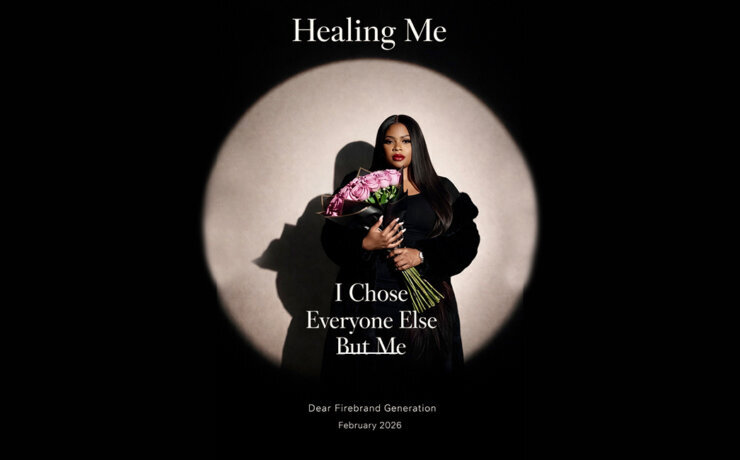
Healing Me: I Chose Everybody Else but Me – February Bonus Edition — Part One

Dear Firebrand Generation,

F

February gets loud about love. And right on cue, the question shows up: “So… where’s your Valentine?” This year I almost answered. Then I realized I’ve been asking the wrong question. It’s not “Where is my Valentine?” It’s “Why did I leave myself out?”

We know how to love everybody. Friends. Family. Situationships. People who barely text back. But ourselves? We RSVP “maybe.” No dramatic altar call.

Just a quiet pause. Turns out I wasn’t selfless. I was disconnected. I thought loving others well , meant running on empty. Plot twist: God never asked me to abandon myself to prove I could love.

I CHOSE EVERYBODY ELSE BUT ME

I gave love fluently. I served faithfully. I showed up consistently. I poured into people, assignments, relationships, and callings with sincerity and depth. Loving others wasn’t hard, it was instinctive. What I didn’t know how to do was turn that same care inward. This wasn’t arrogance.
This was an absence of identity.

When you operate under false identity, love becomes something you offer outwardly in hopes that it will return inward. When identity is unclear, generosity becomes a language of survival. “I mattered when I was useful. I felt safe when I was needed. I felt seen when I was giving.”
It was a trap. And I built it myself. Without realizing it, I learned how to love myself, but never toward myself.

WHEN FAMILIAR LOVE FEELS NOBLE

There is a kind of love that looks noble but is rooted in survival. And there is a kind of love that begins with wholeness. Familiar Love loves outward but avoids inward. It feels responsible for everyone else’s healing. It confuses self-denial with holiness. It knows how to show up, but not how to rest.
It gives what it hopes will one day come back. This kind of love doesn’t come from malice. It comes from patterns, imposter-rooted worth, orphaned expectations, trauma bonds that equate being needed with being loved. Familiar love survives. But survival was never the goal.

FREE LOVE TELLS A DIFFERENT STORY

Free Love begins with self-stewardship. It understands capacity. It honors boundaries without guilt. It receives without suspicion. It knows that love doesn’t have to hurt to be real. Free love is not louder. It’s steadier. Free love is sustained. I realized, I had been operating in familiar love while calling it faithfulness.

THIS IS NOT WORLDLY SELF-LOVE

Let me be clear. This is not self-obsession. This is not isolation. This is not “I don’t need anyone” energy. This is kindness toward your own humanity.
This is considering your emotions instead of dismissing them. This is doing the hard work of growth instead of avoiding it. This is allowing God to tend to you, not just work through you. Self-love in the Kingdom is stewardship, not worship.

THE MOMENT OF PAUSE

I didn’t lack love. I lacked permission. Permission to rest. Permission to receive. Permission to matter without producing.

It was a Tuesday morning when I made coffee and didn’t immediately reach for my phone. It was the space between one obligation and the next, where I heard my own breath and it sounded like a stranger’s. 
The hardest realization wasn’t that others failed me. It was that I never chose myself. And before healing could begin… I had to stop. And in the silence I feared would judge me, I heard a different invitation: to be found.

To be continued.


Reflection Prompt
Where have you been loving faithfully, while quietly leaving yourself out?
 

Feature Image-February-2026
Newsletter

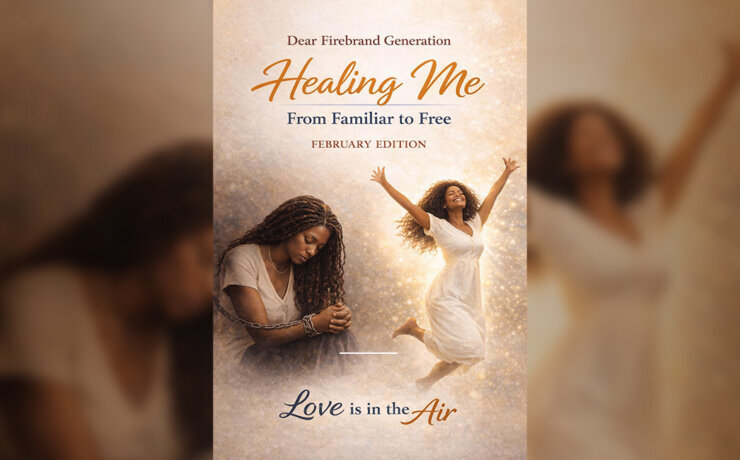
Healing Me: From Familiar to Free-Part 3

Dear Firebrand Generation,

F


February speaks loudly about love. Romance is packaged as celebration, but beneath the flowers, Celebration and captions, many of us carry a quieter truth: Love has not always felt safe. It has felt familiar.  And familiarity, when shaped by trauma, can quietly become a trap. We don’t always choose love based on what is healthy. We often choose it based on what our nervous system recognizes.

When Familiar Feels Like Home.

Different people. Same emotional blueprint. “Patterns are memories trying to resolve themselves.” What feels magnetic is often what feels known.  

What feels intense is often what feels familiar. What feels like chemistry is sometimes the body’s response to unresolved pain. This isn’t because we want dysfunctional bodies, it’s because the body remembers before the mind understands.

The Love We Learned Before Words

Most of us learned love long before we had language for it.  We learned where affection was inconsistent. Where safety was unpredictable. Where attention had to be earned. So, we adapted. Some learned to chase. Some learned to fix. Some learned to perform. Some learned to endure. Later, we called these patterns love not because they were healthy, but because they were familiar.

Why Safe Love Can Feel Uncomfortable

Peace can feel unfamiliar to someone raised in chaos. Consistency can feel suspicious. Calm can feel empty. “The soul learned love in survival, not safety.” Your nervous system became accustomed to adrenaline and uncertainty. So, when healthy love arrives, steady, kind, clear, it can feel strangely quiet.  Not because it lacks depth, but because it no longer activates the old alarms.

Where the Pattern Meets the Soul

For years, we tried to explain love from one side at a time. Psychology named attachment – wounds, trauma – bonds and repetition, faith names identity- truth and restoration.

 
But healing lives in the intersection.

Psychology explains what is happening. Faith reveals why it keeps returning. What the body learned in survival, the soul must now unlearn in safety.

The Shift from Familiar to Safe

Trauma bonds form when love and pain arrive together. Intensity replaces safety. Chaos replaces clarity. “Healing love does not arrive with chaos. It arrives with clarity. ” Healthy love does not require you to chase, shrink, or perform.” It does not punish honesty or reward silence. It may feel quieter. Slower. Less dramatic. But it is not empty. It is spacious.

February’s Invitation

This month is not asking you to give up on love. It is asking you to relearn it.


Ask yourself:  

– What does my body recognize as love?  

– What have I learned to tolerate that I no longer need to?  

– Who am I trying to heal through the people I choose?  

Wrapping It Up

Dear Firebrand Generation,

Repeated relationship patterns are not proof that you are broken. They are evidence that something inside you is still healing. You are allowed to stop reenacting what hurts you. You are allowed to choose love that does not cost you your peace. This is not about perfection. It is about awareness and awareness is the doorway to a new kind of love.

Firebrand Quotes

“Psychology named the wounds. Faith named the restoration.”

“Psychology explained the pattern. Faith restored the person.”

“Healing happens where insight meets identity. The mind explains what happened.”

“The soul decides what changes. Wholeness lives in the intersection.”

“Stop auditioning for your past story. You’ve already outgrown the role.”

Quote of the Month

“Psychology gave language to the pain.

Faith gave authority to the truth.”

– Dora Mensah
 
Welcome to the month of love.  Welcome to Healing Me. Keep reflecting. Keep healing. We’re with you.

January-hero-image
Newsletter

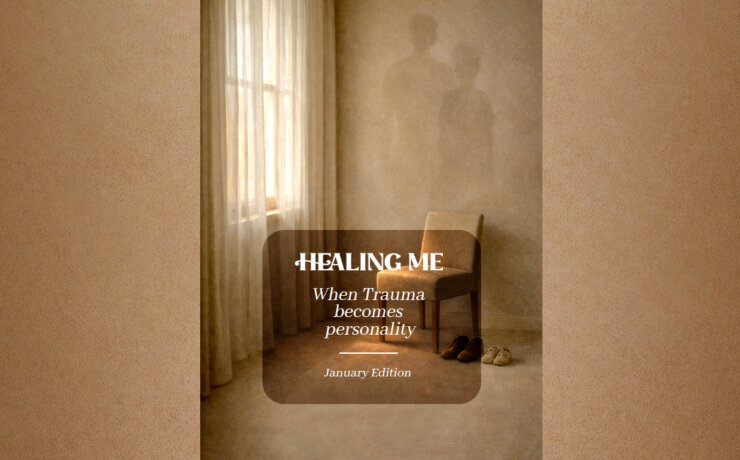
Healing Me – When Trauma Becomes Personality-Part 2

Dear Firebrand Generation,

J


January arrives quietly. Not with fireworks or declarations, but with space. With stillness. With the weight of what did not end when the calendar changed. A new year does not erase old patterns. It only exposes them. Because while we love the language of “new beginnings,” many of us stepped into January carrying the same inner rules we learned long before adulthood. Rules we didn’t choose. Rules that chose us. And as this year opens, Heaven is not rushing us forward. It is calling us inward. Because healing does not begin with becoming someone new. It begins with recognizing who you had to become to survive.

THE PERSONALITY YOU BUILT TO STAY SAFE

Most of us don’t remember the moment it happened. There was no announcement. No warning. Just a quiet decision made by a younger version of us: This is not safe. I need to adapt.

And so we did. We became quieter. More agreeable. Emotionally contained. Self-sufficient. Responsible beyond our years. And over time, survival hardened into habit. Habit shaped behavior. Behavior became personality. We learned how to function. But functioning is not the same as healing.

STORY ONE: THE WOMAN WHO CALLED IT “JUST HOW I AM”

She said it easily, almost proudly. “I’m not emotional. I don’t really need much. I’m easygoing.”

But as we talked, another story surfaced. As a child, she learned that expressing emotion caused tension. Needs were inconvenient. Questions were unwelcome. So she learned to manage herself. She learned to read rooms. She learned to adjust before asking.

Not because that was her nature, but because it was safer than being honest. By adulthood, her adaptability had become invisible. Even to her.

She didn’t see avoidance. She saw peace. She didn’t see emotional distance. She saw maturity. And it wasn’t until she found herself exhausted in relationships, always accommodating, rarely known, that the truth emerged: “I don’t actually know what I want. I only know how to adjust.”

That wasn’t personality. That was survival wearing a familiar face.

STORY TWO: THE MAN WHO NEVER NEEDED HELP

He was known as the reliable one. The man who figured things out. The one people called when something broke. The one who always said, “I’ve got it.” He learned early that needing help slowed things down.

As a boy, chaos lived in his home. Inconsistency. Pressure. Responsibilities that arrived too soon. There was no space to fall apart. No room to be unsure. So he learned to observe, adjust, and carry weight long before it belonged to him. He became capable before he became cared for.

By adulthood, his competence was praised. His independence admired. His strength affirmed. But what no one saw was the quiet exhaustion underneath it all. Because carrying everything meant no one ever carried him. He didn’t resist vulnerability because he lacked emotion.

He resisted it because he learned early that depending on others was dangerous. And one evening, after years of being everyone else’s anchor, he said something that stayed with me:

“I don’t trust that anyone will show up for me.” That wasn’t pride. That wasn’t personality. That was a boy who learned that survival meant self-reliance.

PSYCHOLOGICAL INSIGHT (Between Story Two)

Over-functioning is often mistaken for strength. But hyper-independence is not confidence. It is a response to environments where support was unreliable or absent. When a child learns that no one is coming, they stop asking. They become capable. They become efficient. They become necessary And those traits are rewarded, until intimacy requires something different. Healing begins when the nervous system learns that support is no longer a threat.

A MESSAGE FOR BOTH STORIES

Different lives. Different adaptations. The same truth. Some of us learned to survive by becoming invisible. Others learned to survive by becoming indispensable. Both are survival responses. Both deserve compassion. Both require healing.

January is not asking you to reinvent yourself. It is asking you to recognize yourself. God is not just healing memories in this season. He is healing patterns. He is healing identities shaped by fear. He is healing the version of you that learned to survive without safety. Because some of what you call “just how I am” is actually how you learned to stay alive. And healing begins when you stop confusing the two.

Reflection Questions
  1. What behaviors in your life might be survival responses rather than identity?
  2. Where do you stay quiet or over-function to keep things stable?
  3. Who did you have to become to survive your environment?
  4. What feels unsafe to need or express, and why?
  5. What part of you has been waiting for safety to return?Take your time. This is not self-analysis. This is self-honesty. 
 END OF PART TWO

Part Three continues the journey: Healing Me: Why Dysfunctional Love Feels Familiar

Quote of the Month

“Some of what you call ‘just how I am’ is actually how you learned to survive.”

– Dora Mensah